
After an enjoyable day on the water, many boaters are overwhelmed with anxiety when it’s time to return to their dock. They fear the moment when “all eyes are on me”, as everyone seems to be expecting some entertainment and eagerly waiting to capture it all on their cell phones for instant fame on the internet.
But is a boat hook really the right tool to use as a docking aid?
Growing up at a family marina, Doug witnessed countless boaters using a boat hook to help them dock their boats. Sometimes it worked, but most often it resulted in raised voices, entertainment for the spectators, and sometimes damage to the boat—as well as the Captain’s ego.
As a boat heads down the fairway toward its slip and the trusty expandable boat hook suddenly appears, you can almost anticipate the upcoming entertainment that this new boat crew is about to deliver.
Sometimes the boat hook appears on the foredeck, sometimes in the cockpit. Everyone—except this new boater—knows from experience that boat hooks require two hands to operate with accuracy and strength. This leaves no hands left to hold a dock line and no hand left to hold onto the boat for balance when the Captain unexpectedly jams the shift into reverse.
I asked Doug to describe one of these dockings using a boat hook. He explained it this way:
“One of the many early signs that a docking will be entertaining is when a crew member is on the foredeck holding a boat hook.”

“One day I watched the tragic drama unfold from my boat’s cockpit on the other side of the fairway—too far away to offer any immediate assistance.
This couple, with no passengers, were entering the calm fairway in their 30-foot twin-engine cruiser. It should have been a smooth and uneventful docking.
As George idled his boat down the fairway toward the slip, Martha struggled to inch her way up the narrow side deck with her trusty extendible boat hook. This was after she recovered from getting it tangled in the cockpit canvas supports and then the side-deck rail stanchions. The side deck was narrow, requiring one hand to hold on while moving forward. This left only one hand to manage the boat hook.
Once she reached the foredeck, she carefully placed the boat hook on the sloped deck to prepare the bow line. The pole immediately started rolling toward the water. She stomped on it just in time to keep it from going overboard.
As George steered their boat into his slip, he developed what I call ‘The Last 50 Feet Syndrome.’
Martha was petrified.
Just as the bow got too close to the dock, Martha grabbed the boat hook to push the bow away—but it was too late. The boat touched the dock. Without warning, the boat hook suddenly retracted and Martha went head-first over the bow rail into the cold water.
George yelled to Joe, who was two slips away.
‘Hey Joe, help! Martha has fallen into the water in our slip!’
Joe raced over and called out, ‘Martha, give me the end of the boat hook. I’ll pull you over to the ladder.’
As he pulled her toward the ladder, the boat hook came apart. Joe lost his balance and almost fell into the adjacent slip.

Martha managed to reach the ladder and climb out of the harbour water while Joe helped George tie up the boat.”
Doug paused and smiled.
“This is definitely not the way to endear your wife to the joys of boating.”
Doug had many more stories like this, but the lesson here is to figure out what went wrong.
The Boat Hook
Not a Good Docking Aid
Doug explains why. “I don’t recommend using a boat hook as a docking aid for many reasons.
A trained Captain using the engines can position and control the boat far better than anyone trying to push or pull it with a pole. When the boat is handled properly, the First Mate and crew simply step off safely and tie the lines.
The only circumstance where I’ve seen a boat hook used properly during docking is when backing into a slip with a pair of pilings.
In this situation, the two bow lines are pre-tied to the pilings and waiting on the tops of the posts. As the boat backs into the slip, the crew on the bow simply reaches out with the boat hook, lifts one dock line loop off the piling, brings it aboard, and ties it loosely to the bow cleat. Then they repeat the process on the other side, center the boat, and secure both lines.
No pushing.
No pulling.
Just retrieving the line.”
A Little History
Decades ago, pike poles were long wooden poles used for reaching, holding, or pulling. They were commonly used in construction, logging, and firefighting.
These poles had sharp points and hooks designed for pushing and pulling logs or timbers so they wouldn’t slip. Their handles were typically 10 to 12 feet long.
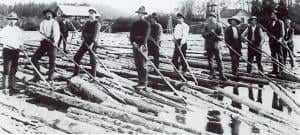
They were not suitable for pleasure boats because of their sharp points.
For boaters, the familiar six-foot boat hook was designed as a reaching tool—to help retrieve a loop from a piling, place a line over a post, or pick up items that fall into the water. Boat hooks have rounded ends and hooks so they won’t scratch or damage boats or docks.
How the Definition Changed
Boaters without proper docking skills began using boat hooks as docking aids—trying to pull the boat toward the dock or fend off if the boat was about to hit.
Over time, the definition of a boat hook slowly changed, and many people now mistakenly believe a boat hook is an appropriate docking aid.
But it isn’t.
Learning to dock through trial and error, which many boaters do, is also not the best way to endear your partner to the joys of boating.
A Better Way
A far better way to dock a boat is to learn proven boat docking techniques that do not require a boat hook and always keep your First Mate safe.
With proper technique, the boat’s engines do the work of positioning the boat while your crew simply handles the lines.
That’s why we created docking lessons.
Doug Dawson’s proven docking techniques are working for thousands of boaters worldwide, with no need for yelling, swearing, jumping, boat hooks, bionics, dock helpers, guesswork or embarrassment.


For open-minded boaters who would really like to improve their docking skills—even just a little—and, more importantly, keep their First Mates safe, give it a try.
Invest in an Introductory Docking e-Lesson .
It costs less than a couple of burgers and sodas. That’s all that is separating you and your First-Mate from the dangerous use of the entertaining and embarrassing boat hook.
https://www.boatingwithdawsons.com/how-to-dock-a-boat/ Order the Docking e-Lesson designed for your boat’s drive system today… and you will find that your boat hook stays stowed where it belongs.